
















Most organisations no longer need convincing that climate change will affect them. The harder question is whether they have a credible plan for navigating the transition ahead.
That question is becoming increasingly important for boards, investors, lenders, insurers, regulators, customers, and employees. Planning for the transition is rapidly shifting from a disclosure exercise to a business capability. Organisations that can demonstrate a clear, credible pathway to a thriving commercial future are likely to be better positioned to access capital, maintain stakeholder confidence, manage risk, and capture new opportunities.
Yet many organisations are still in the early stages of that journey.
Our new discussion paper, Credible Transition Planning: From Narrative to Navigation, explores what good transition planning looks like in practice, where New Zealand organisations are making progress, and where important gaps remain.
Read the full Credible Transition Planning discussion paper here
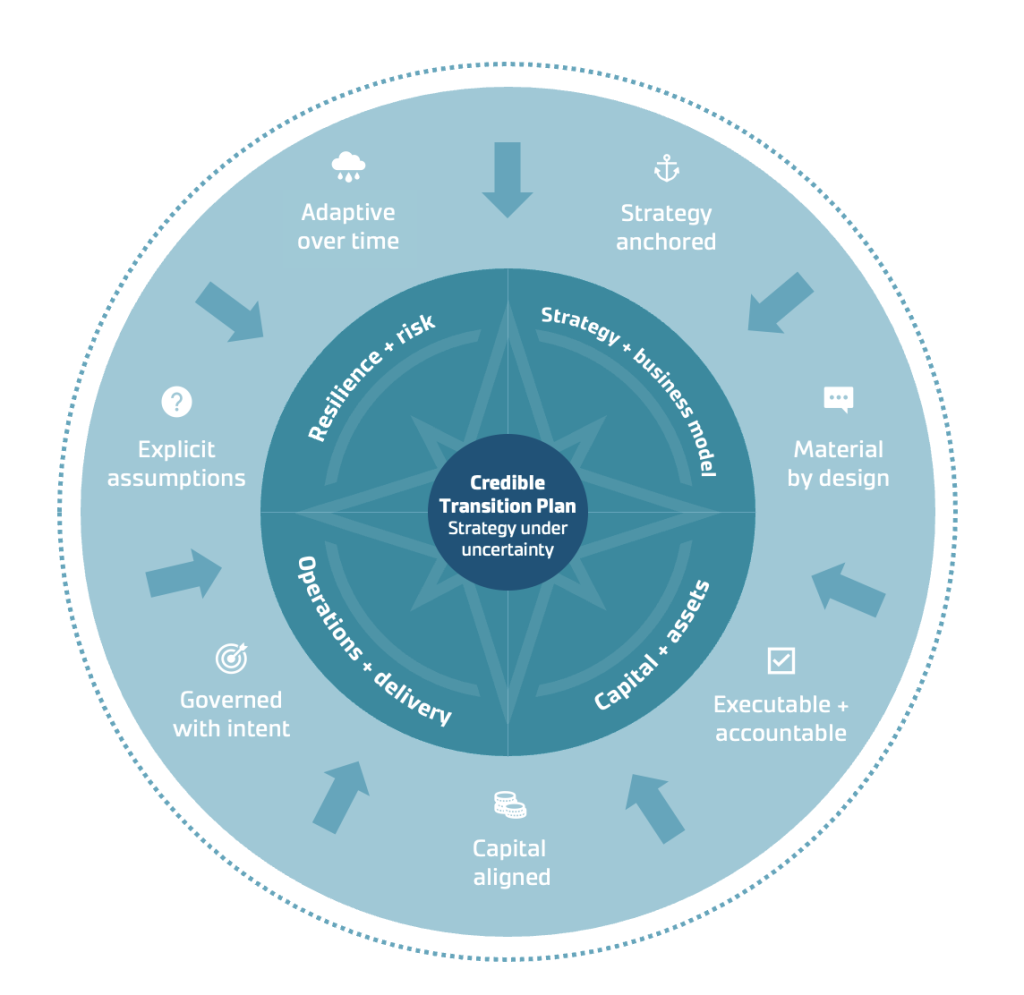
Five gaps emerging from current practice
Drawing on New Zealand climate disclosures, global frameworks, investor expectations, and practical experience supporting organisations through climate-related reporting and strategy processes, the paper identifies five recurring gaps:
- Transition plans that are disconnected from business strategy and capital allocation decisions.
- Targets that lack delivery logic or implementation pathways which don’t make assumptions or contingencies transparently explicit.
- Limited integration of climate adaptation and resilience considerations into broader strategic capability.
- Insufficient disclosure about uncertainty, constraints, assumptions, and decision triggers.
- Treating climate disclosures as an endpoint rather than acknowledging a maturity journey of continual improvement.
None of these gaps are unusual. They reflect the reality that transition planning is still evolving. However, they also highlight where organisations can create the greatest value by moving beyond compliance and more deliberately towards decision-useful planning.
What does good look like in credible transition planning?
The paper proposes seven principles for credible transition planning, providing a practical bridge between disclosure requirements and leading practice.
At their core, credible transition plans are:
- Strategy-led
- Action-oriented
- Financially connected
- Adaptive and resilient
- Transparent about uncertainty
- Governed and accountable
- Continuously improving
Together, these principles help organisations move from describing their climate ambitions to demonstrating how they will be achieved.
The paper also explores the critical connections between governance, strategy, risk management, targets, finance, adaptation, and implementation. In our experience, the credibility of a transition plan often depends less on any single component and more on how well these elements connect and reinforce one another.
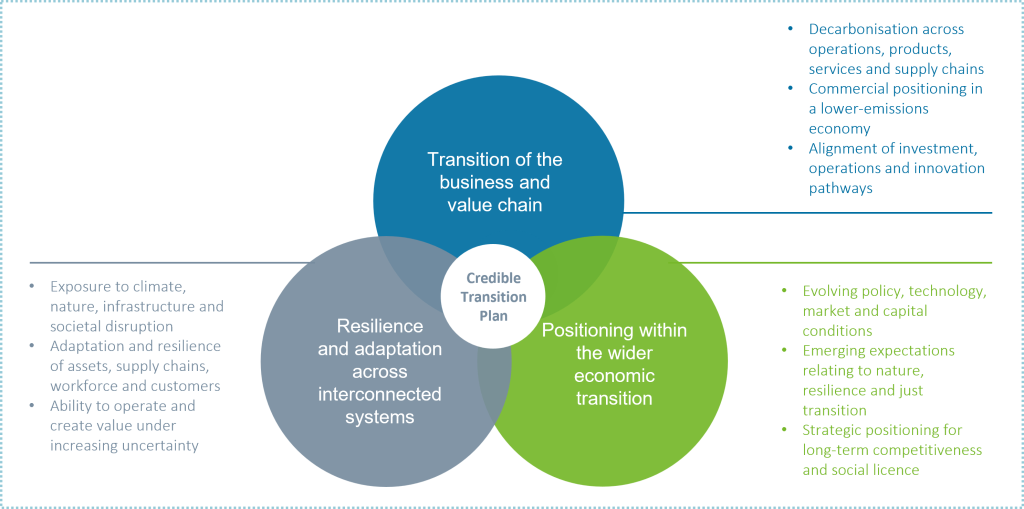
Global expectations are moving quickly
The timing of this discussion is important.
The recent publication of ISO 32212 transition planning standard signals growing international convergence on what constitutes a credible transition plan. While voluntary today, the direction of travel is clear: organisations will increasingly be expected to demonstrate robust governance, implementation pathways, monitoring, review, and continual improvement.
The discussion paper has been updated to reflect key elements of this emerging ISO guidance, alongside other leading frameworks such as the Transition Plan Taskforce (TPT), ISSB, GFANZ, CDP, the World Benchmarking Alliance, and other global initiatives.
At the same time, expectations are expanding beyond emissions reduction planning. Nature-related dependencies and impacts, resilience and adaptation, and just transition considerations are becoming increasingly important components of credible planning. These topics are introduced in the paper and will be explored further in future work.
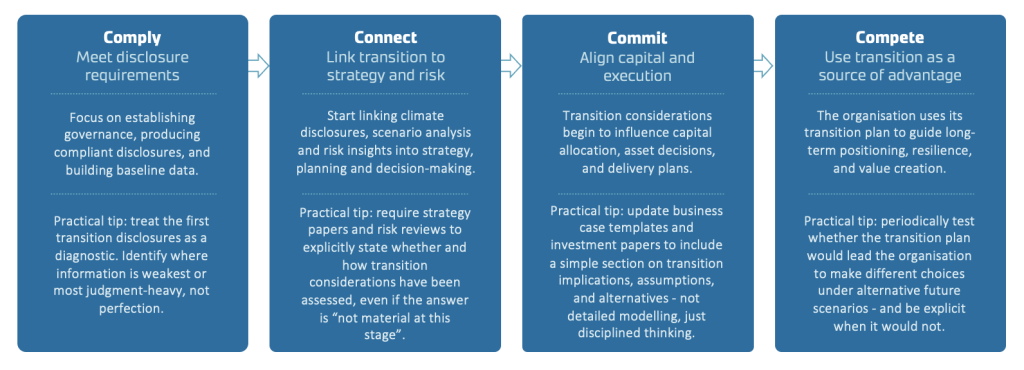
Practical tools to support action
Perhaps most importantly, the paper is designed to be useful.
Alongside insights and analysis, it includes practical tools and frameworks that organisations can apply immediately, including a transition planning maturity matrix that helps boards and management teams assess their current position and identify practical next steps.
Whether you are preparing your first transition plan, refining an existing approach, or seeking to align with emerging global expectations, the maturity pathway provides a structured way to move forward.
The transition is already underway. The question is no longer whether organisations need a transition plan, but whether that plan is credible.
Download the discussion paper to explore the emerging expectations, practical tools, and pathways that can help turn climate ambition into decision-ready action.
About the Author
Simon Harvey | Principal Consultant – Strategic Sustainability, Tonkin + Taylor
Simon is a versatile sustainability specialist with a laser focus on practical approaches to strategy development, measurement and reporting that unlock new value. He has 20 years of experience working with small, medium, and large organisations in both the public and private sectors to develop informed responses to sustainability challenges that complement broader enterprise objectives.
Read more from Simon here:
Good Growth: Accelerating sustainable infrastructure investment
Good Growth: Converging systems for a low-carbon future