






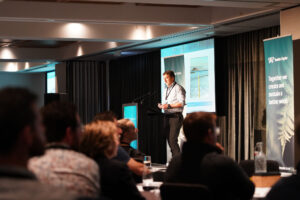

Water New Zealand Stormwater Conference, 2026, Auckland
The Fitzgibbon Stormwater Harvesting Scheme (FiSH) and the Potable Roofwater Harvesting Scheme (PotaRoo) are alternative water supply systems located in Brisbane, Australia. The schemes were conceived during the Millennium Drought and constructed between 2011 and 2013 as part of the Fitzgibbon Chase Priority Development Area.
The FiSH was designed to capture stormwater from an urban catchment and treat it to a standard suitable for non-potable household uses via a dual reticulation network.
The PotaRoo was designed to capture rainwater from residential roofs and treat it to drinking water standards. Together, the schemes were intended to demonstrate decentralised, alternative approaches capable of reducing demand on the centralised drinking water network.
Despite successful design, construction and commissioning, neither scheme entered full operation. A recent trial recommissioning program provided an opportunity to operate the treatment plants and evaluate their performance.
During the trial period the FiSH produced approximately 64 ML of non-potable water, sufficient to supply roughly two-thirds of community non-potable demand. The PotaRoo produced approximately 36 ML of drinking-quality water, representing approximately 44% of estimated potable demand. Production costs were estimated at $3.63–$4.03/kL (AUD) for the FiSH and $3.96–$4.69/kL (AUD) for the PotaRoo, excluding capital recovery. These costs are broadly comparable with the retail price of drinking water in Brisbane.
The Fitzgibbon schemes demonstrate that technically sound alternative water supplies can be delivered. However, their long-term viability was determined not by engineering performance but by changes in climate conditions, regulatory frameworks and institutional priorities. There are lessons to be learned from this case study that can apply to any jurisdiction, including New Zealand.